Friday, 10 January 2014

The England riots of 2011
What caused the riot? And who was involved?
The riots of 2011 in England were sparked by the killing of mark Duggan. He was a British dad of 6 who had been heavily linked with drug dealing. The police had been linked to the man because they knew of Mark Duggan relatiionship to the underground drug business. As well as him buying a gun just 15 minutes before his death. Mark Duggan, after getting the illegal weapon got in a taxi. Armed police in unreserved cars followed the taxi, until they stopped mark Duggan, he was known to have had a gun and this why the police shot and killed. However, the controversy came because before he was killed, a jury heard that he had in fact got rid of the gun. Although of this, the police were found innocent of his murder on the 7th January 2014.  This was after he was shot in Tottenham, London, on 4th July 2011. It soon became an issue known worldwide, especially with the upcoming Olympics being held in London.

However the killing of Mark Duggan was not the overall reason for the riots. Rioters and others citizens of Britain, mainly those of working class, felt that they had been taken advantage of by the government and the riots were started because people believed that they were not being given equality. In the year prior to the riots, the British government had become conservative. This is a right wing political group, who had made promises that would later turn out to be lies. This angered those in less fortunate economic positions because the government began to raise taxes for all, however this left the working class in a position where they barely had enough money to live.

The impact of the riots was that people all over the world now saw London as a dangerous place. This was a negative for the British as the Olympics of 2012 were soon coming, and people wouldn't want to travel to watch the Olympics if there is a big risk of danger. There was also an impact on the peoples who business had been destroyed by the rioting. Many rioters seemed to be out just to cause mayhem with no reasoning. They viewed a crowd of people like them being able to commit crime without punishment and decided to take advantage of the situation. The British media called this the ‘copycat criminals’. This was evidently true as the riots spread from borough to borough across London until it initially left London and become a national concern.
Different social, political and economical aspects of the riots.
The riots that took place in England form the 6th august till 12th august can be viewed from many different angles. First being, the social impact on the people of England. Businesses that had been destroyed were those that in the economic state were needed by the people to survive. Thousands pound worth of damage caused, which in effect would be coming out of the pockets of those who rioted, leaving the poor in a less fortunate position than before the riots.There was deaths related to the riots.One example is the death of 3 Muslims who were the victims of a hit and run which is suggested to be a racial attack. This was after the 3 men took to the street to protect there independent business.
The political aspects of the riots were that it put immense pressure on the government. David Cameron, the current British prime minister was on holiday when the riots began and did not seek to return until after 10th august. This was seen by the public to be an outrage; in the biggest crisis of his career the prime minister was nowhere to be seen. In fact, there seemed to be no control in his absence. Nothing was being done by the government, which angered those of the public that weren't committing criminal acts. It also added the pressure that, if the government are not reacting to the crises then why not join the crisis.  If there are to be no consequences of destroying a city, day and night then why not join in? These were the questions that those of the public were asking. A long with 'when will something be done?' 'When will it stop?' The pressure caused the government to cancel all police holidays and called back parliament on 12th august.
the economical aspect of the rioting was also severe. Due to businesses having to be closed people lost income, this meant people were unable to put back into the government. Resulting in the decrease of the economic state of England.

Who was under criticism?
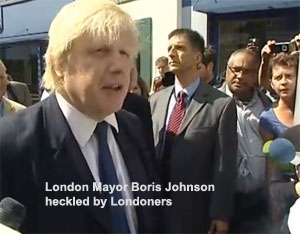
Mayor of London, Boris Johnson faced severe criticism from local residents, who complained that they had not had enough protection from police. "I also want to say to the people who have been involved in instigating these riots, those who have been robbing and stealing, that they will be caught, they will be apprehended and they will face punishments that they will bitterly regret." However the people at his speech were not convinced, the crime that had occurred in the recent week did not affect Boris Johnson. Reportedly being in North America whilst the riots happened, when asked, “why didn't you return quicker?”  He replied “I came as fast as I could” He returned 4 days after the riots began.

"http://www.youtube.com/watch?v=BQksa-KSV4Y"
This video shows the riots in action. As well as showing the lack of police support provided by the government.

Thursday, 9 January 2014

Growing Middle Class in China- Selina Lassman


 Growing Middle Class in China


This issue is just being brought to everyone’s attention, over the past 10-15 years; the middle class in china has risen to over 25% of their population. To be considered middle class you have to have an income between $10,000 and $60,000 a year and living in the city as opposed to suburbs is considered to be middle class in China. With China growing over the past 20-30 years there have been a lot more business and entrepreneurship opportunities. Many Chinese state companies have employed many people and China has had their income triple in the past 10-15 years with the middle class rising. Being middle class you have more money to spend on things you don’t need to survive. They’re retail is going up and demanding a lot more services. Being a younger part of the middle class you tend to
have different wants and needs. The younger generation are into a lot of luxury and brand named items. Also being a younger part of the middle class generation you’re more likely to wait off to have children and want to explore the world before starting a family. Upper middle class citizens are educated and have learned how to speak foreign languages, allowing them to travel and wanting to travel more. This will be bringing in tourism to other countries other than China. This rise of the middle class in China gives other countries a lot of new opportunities such as companies selling and relocating to China. Being middle class in China they’re willing to pay high prices for quality products and can afford to spend the money on these types of materials and services. Having more money allows you to do more things in your life such as travel. The service industries will/is rapidly increasing. Their willingness to spend their money on goods and services such as entertainment, leisure, care services for the elderly and education. Being on the outs of middle class it’s hard to get in and make something of yourself. Most people in China that are off living in the country have a very slim chance of becoming middle class. They tend to not allow people from the country into the city. As time goes on its improving and offering some people from the country jobs in the city because they want to get majority of the population to become middle class. With China being a communist/democracy country with the rising of the middle class China has a very strong possibility of changing to a democratic country, this would be caused by the uprising of the middle class. The only way the middle class could ever change to an upper class or lower class is if they become a democratic country. China has one of the most stable economies because of their permanent middle class. It creates a stable flow of income for the government because of everyone being able to afford their dues.  In the future they’re predicting that 50-60% of China's population will be middle class China's new middle class is changing the economy and having a rapid impact on other countries. They need to be prepared and ready to keep up with China's demands and preferences. If China does become a democratic country the economic structure will change drastically because they’re going to have three types of classes upper, middle and lower class instead of just one.

The Fur Farms of China- by: Kayla

The Fur Farms of China

By: Kayla Peters
No matter where you go in the world, animals are always being abused. However, nothing seems as horrific as what happens in the fur farms of China.  China provides over 60% of the world’s fur from animals such as raccoon dogs, black, red and grey foxes, stray cats and dogs and other typical “fur” species. There is no labeling system for fur in China so when a coat says “fox fur produced in China,” it is very seldom true. The coat could be cat, dog, raccoon or fox without any way to tell for certain. Since there is a huge stray dog problem is Asian countries, often the solution to reduce the population of stray dogs is to catch them for either food or fur.
With each farm holding two hundred to three hundred animals, the animals are subjected to very poor care during their lifetimes and during their deaths. The average cost to raise an animal for fur is $45CAD yet the average pelt (fur of the animal) is sold for $89CAD. Chinese claim that since the cost to raise the animal is so high and the selling prise so low, they cannot afford humane methods of slaughter for the animals.
In the fur farms there are only a handful of “lucky” animals. These “lucky” animals slaughtered by a method called anal probing. In this method, one metal rode is inserted to the animal’s anus while another is forced down the animal’s throat. The animal is then electrocuted until death. This method is considered one of the more humane options but is costly so it is barely used.
The rest of the animals go through a much more painful event. This method includes beating the animal’s head with a hard object such as a metal rod, stick, brick, foot or by picking the animal by the hind legs and slamming him or her to the floor. The object of this is to kill the animal but the majority of the time, the animal survives this with only a head injury. The animal is then tied up from their hind legs and they are skinned alive. The skin is cut around the legs and the person skinning the animal will use their body weight to pull the skin off from their feet to their head. Once the skin is removed, the body of the skinless animal is thrown into a pile, like garbage. What makes this practice so terrifying is not the fact that 90% of the animals are skinned while still conscious; it is that they will survive for 5-10 minutes after being skinned, eventually dying from heart failure or suffocation from the other bodies being piled on top of them.
Raccoon dog still alive after skinning
Many wonder how this practice is still allowed, why there are now laws or regulations surrounding animal welfare. In China, there are very few laws regarding animal welfare, and when the animal is in a fur farm, there are none. One of China’s only laws is the Law of the People’s Republic of China on the Protection of Wildlife, also called the Wildlife Protection Law (WPL). In this law, it states that any wildlife is considered to be a natural resource and shall be used as such. Since fur farmer make more money than most Chinese citizens, they bring in a lot of money for the towns that they are situated in, therefore fur farming is promoted and fur farmers are considered to be heroes. Fur farms can also employ up to 50% of an average farming village population either directly or indirectly.
It seems as though nothing will change the situation in China regarding the fur industry and that there is very little hope for animal activists or the animals themselves but it has only been in the past few years that this issue has been brought to light. With more light being brought to the issue, less people will find fur products attractive which will decrease the market for fur and eventually save the lives of thousands of innocent animals.  

A shocking look inside chinese fur farms. (2014, January). Retrieved from Meredith, C. (2013, March 01). The true face of china's fur farms. Express. Retrieved from http://www.express.co.uk/news/world/381117/Animals-electrocuted-strangled-and-skinned-alive-The-true-face-of-China-s-fur-farms
Tobias, M. (2012, February 01). Animal rights in china.Forbes. Retrieved from http://www.forbes.com/sites/michaeltobias/2012/11/02/animal-rights-in-china/http://features.peta.org/ChineseFurFarms/

Blake, M. (2013, November 25). Chinese "fox farms. Daily mail. Retrieved from http://www.dailymail.co.uk/news/article-2513288/Chinese-Fox-Farms-animals-clubbed-death-skinned-fur-trade.html


WMD In Syria

Jon Smits: Syria`s Biological/Chemical
WMD

    Biological/chemical weapons are weapons intended on killing or incapacitating humans, plants or animals. There are a variety of agents able to be used in bio-weapons, which can include; bacteria’s, viruses, and fungi, which are intended to kill, incapacitated or disorient the enemy.  Biological weapons are used mainly by what we consider terrorist groups and are classified as bio-terrorists. However biological weapons can turn into a chemical weapon caused by the massive infection rate of the biological agent used and can cause hundreds of deaths. Biological weapons where outlawed in 1972 to prevent biological attacks that result in a large number of civilian casualties.
Ghouta Chemical Attack

Syria a county in the Middle East has broken this ban on chemical and biological weapons only a year after the outlawing of these WMD occurring from Egypt as a defence against any military action. On July 23rd 2012 Syria announced to the world of their stockpile of biological and chemical weapons. However during the Syrian civil war started in August of 2012 the Syrian military restarted their chemical weapons testing in a base outside of Aleppo just south of the Turkey border. Much of the western powers discussed an intervention into this conflict as a consequence of the stockpile and accused use of these weapons.

 Syria was integrated into the Organisation for the Prohibition of Chemical Weapons after the Ghouta chemical attack where close to 2000 people died including a mere 51 rebel fighters, most of the western powers held Syria responsible for this attack. Recent Intel puts the Syrian stockpile at close to 2,000 tonnes of chemical weapons including Yperite, VX and hundreds of tonnes of sarin. (Yperite a type of sulphur mustard gas, VX and Sarin both very deadly nerve agents.) One of the main issues that surrounds Syria is it’s smallpox program, in which the UN and most other powers fear Syria has been able to stockpile massive quantities of the agent and have enhanced the agent to become more lethal. The enhancements have made the agent highly infective and very transmissible or the ability to pass between patrons easier; it also has a lengthy incubation period making it harder to spot at earlier stages and has been modified to overcome any medical countermeasures. In light of this discovery this has made Syria’s biological complex far more dangerous than their chemical facilities, but the current world powers are fixated on they’re chemical facilities possibly leaving them with a very dangerous capability. It is said that Syria has many Scud-D and Tochka launchers with multiple air and artillery delivery systems.

On October 13 2013, the OPCW found a stockpile of roughly 1,300 tonnes of chemical weapons within Syrian bases. On October 16 the OPCW and the United Nations confirms a joint mission to oversee the transport and elimination of all Syrian chemical and biological weapons and manufacturing equipment by mid 2014. On January 7th the first shipment of chemical weapons seized by world powers left the port of Latakia on a Danish ship where it is to be taken to Italy and transferred to a US Naval ship set to be destroyed in international waters via a titanium tank filled with water on the ship to safely detonate the weapons. This conflict is still on ongoing struggle to secure and dispose of all weapons.

For More information see: http://www.medscape.com/viewarticle/431311
http://en.wikipedia.org/wiki/Syria_and_weapons_of_mass_destruction

Egypt In Crisis

Egypt since its birth as a state has been a regional power. After the 2011 protests and the ousting of Hosni Mubarak, the dictator, Egypt has seen a lot of violence and bloodshed. The Muslim Brotherhood, an Islamist party, had a major part to play in the ousting of Mubarak, and was seen as the successor to lead Egypt out of the crisis. Muhammad Morsi, the leader of the Muslim Brotherhood took power after democratically being elected by the Egyptian people. After taking over the office, Muhammad Morsi started to grant himself more power, and sink the military leadership, which was the main power of Hosni Mubarak. Morsi asked the top military generals to retire and appointed Abdul Fattah el-Sisi as the new defence minister. Muhammad Morsi continued to grant himself more power in the coming weeks and was met with a hostile reaction from the Egyptian people. Hundreds of thousands of people started to protest at the presidential palace against the new powers that Morsi granted himself. The military and police, who were against Muhammad Morsi for his Islamist views, allowed the protests to surge to the palace walls. The protests started to get bigger and bigger, and saw a return at the Tahrir Square, two years after the ousting of Mubarak. The people were protesting against Morsi on the two year anniversary of Mubarak`s ousting at Tahrir Square. As the protests gained media attention and publicity, the military threatened to intervene if Morsi did not take the right course of action. There was no change in the peoples say, and the protests continued. The military, under the leadership of Sisi, gave a 48-hour warning to Morsi, threatening to intervene in the issue if a political solution was not reached. Morsi replied with ``I will not let anyone to dispute my legitimacy. This is unacceptable. Unacceptable! ``. 

This caused a huge confrontation between the military and The Muslim Brotherhood. Muhammad Morsi`s supporters took to the streets to protest against the military for unjustly removing a democratically elected leader. The military replied with crushing the protests with violence and bloodshed. Recent protests were crushed with heavy armoury and tanks of the army. The military killed around 1000 people in one day of the protests, running over people with tanks and armoured vehicles to show a message to Morsi`s supporters. Morsi was removed from office by the military and put under house arrest. The military issued arrest warrants for over 300 Muslim brotherhood officials. Muhammad Morsi is currently under trial with many charges. The violence between Muhammad Morsi`s supporters and the military has been increasing. Morsi supporters demand an end to the military dictatorship, which they fought against Hosni Mubarak in 2011. It seems like the same situation is coming into play for Egypt. The military is ruling, while the majority of the country is in the support of a different party. The supporters of Muhammad Morsi have taken up arms against the military and there is heavy fighting going on inside Egypt, specifically Sinai Peninsula, near the border with Gaza, a region full of Islamist Morsi Supporters. The military has stepped up offensive against Islamist militants in Sinai, and since then, there has been heavy fighting between the militants loyal to Muhammad Morsi and the military.
Muhammad Morsi had a soft spot for Palestine and had made numerous remarks against the oppression of Israel. The military was against the Islamist militants loyal to Palestine and this was the main reason of confrontation against the Muslim Brotherhood and the military. The current situation looks as if it will only get worse. There is a split in Egypt as to the support for the military and the Muslim Brotherhood. Egypt must work towards reaching a bilateral agreement; otherwise there is a danger of widespread violence and bloodshed within the civilian population. Egypt is currently on the course of a civil war.

The following video shows how the military and security forces of Egypt oppress the supporters of Muhammad Morsi.
http://www.youtube.com/watch?v=d5Tbxkz14yo


Abdulbasit Malik
World Issues

Mr. Blair

References

A possible return to the dictatorship days that Egypt saw during Mubarak. A lot of violence within the country against the military, as the generals overthrow Morsi and put him on trials for false accusations.

Profile of Muhammad Morsi, the former democratically elected leader of Egypt. An overview of how he came to power and how he was unjustly overthrown.

The Muslim brotherhood, the party of Muhammad Morsi speak about the crisis in Egypt and why it has gotten worse, and why it will continue to get worse. 

How countries in the region are responding to the growing violence and unrest in Egypt.

The political unrest and violence is damaging Egypt's economy and ruining the country as a whole.

There is no sense of democracy in Egypt. The military rulers who overthrew the democratically elected government, think that their dictatorship is the just way to rule.

Laura Martinez - Education of Women in Underdeveloped Countries

The countries of our world have been divided by socioeconomic factors into developed, developing and least developed. Today there are 49 least developed, or underdeveloped, countries. An underdeveloped country is classified by factors such as its per capita gross domestic product, the lower levels of infrastructure, and standards of living for its citizens. A trend that can be seen in every underdeveloped country is the low level of education, especially for women. Consequently, this undervaluation of women has caused serious issues for the countries that take part in it. If you educate and empower women in underdeveloped countries there would be serious benefits worldwide. For example, there would be an increase in the GDP of that particular country which helps productivity while fueling economic growth (Global Partnership, 2013). By allowing women to receive an education, she is less likely to be married extremely young; she will have fewer and healthier children (Because I am a Girl, 2013). Despite the obvious benefits that will take place by introducing women in underdeveloped countries to a proper education, it has not been easy. In many cases it is not simply women of poor economic standing being unable to attend schooling. It is as well women and girls who have families with a good level of economic standing who are actually forbidden to attend school past a certain age. If society across the globe were to place more focus on educating women, it would create a domino effect- one that brings forth solutions for issues that have been around since the development of modern society.


Around the world, 1.4 billion people live on only about $1.25 per day. The minimum wage in Ontario is currently $10.25 and the average number of hours worked are 8, meaning the average person would earn $82 a day. This means that 1.4 billion people are only making 1.5% of what we do on an average work day, and 70% of these 1.4 billion people are women (Because I am a Girl, 2013). Globally, almost 61 million children are deprived of an education, with 36,600,000 of these children being girls (Alter). Studies show that for every year a woman stays in school, her income can increase by 15 to 25%. This would further increase the gross domestic product of a country by 3%, reducing the billion dollar loss that occurs when women are not educated to the same level as men are (Global Partnership). 

In places where women are uneducated standards of living are much lower, making basic necessities such as clean water and good health a privilege instead of the right it should be. When women control the family income, she is more likely to spend the money on food and children's needs, increasing the child's chances of survival by 20%. By having even a basic knowledge of mathematics, women now are properly equipped with the tools they need to manage the budget. In areas where diseases like HIV/AIDS are rampant, women need to be better educated on how they can keep themselves and their children safe, letting them focus more on food preparation and nutrition instead of taking care of terminally ill family members. Studies from Africa determined that mothers that spent five years in primary education have children that are 40% more likely to live past 5 years old (FAO). Educated mothers are more likely to be working, averaging fewer children and allowing them to pay more attention to each individual child. They are also less likely to have unplanned pregnancies, giving them a chance to better finance a fewer number of children leading to a higher level of education (UNFPA). 


Getting proper education to women in underdeveloped countries is not only difficult but sometimes even dangerous. In the case of Malala Yousafzai, it actually became deadly. Her father from a young age fought to be educated and then went on to create schools for boys and girls. Soon after, the Taliban came into Pakistan and enforced a very strict new way of life. By the end of 2008 they had destroyed 400 schools, and by January 14 2009 every single school for girls was permanently closed (Roberts). Upset by this, 11 year old Malala wrote on her blog, "They can stop me from going to school but they can't stop me learning." In May, her family joined the 2 million people fleeing the Swat valley. She then decided to become an advocate for education and children's rights, giving speeches and television interviews. Death threats were made repeatedly against her, and she eventually became the victim of an assassination attempt. On October 9 2012, a masked gunman shot her in the head after shouting "Who is Malala." A week later Malala woke up in a hospital in Birmingham, England. She is still a strong champion for education and human's rights, speaking against forced marriages and the denial of education. In March 2013 she was a serious contender for a Nobel Peace prize, and in October 2013 Malala and coauthor Christina Lamb released her memoir "I am Malala: The Story of the Girl Who Stood Up for Education and was Shot by the Taliban."


The issue of education for women has been becoming more prevalent in modern society, with the "Because I am a Girl" campaign in full effect. With determination and a real thirst for change, the world can help women in underdeveloped countries reach their full, unexplored potential. 


FAO Programme ::: Food security. (n.d.).Food and Agriculture Organization of the United Nations. Retrieved January 9, 2014, from http://www.fao.org/gender/gender-home/gender-programme/gender-food/en/

The World and Whaling By Shane Cowman


Whaling and The world

The earliest forms of whaling go back to 3000 BC. Many coastal communities across the world where whales can be found have long lines of historical roots in whaling and harvesting beached whales. Industrial whaling became relevant with organized ship fleets in the 17th century. Whaling slowly started to become a competitive industry in the 18th and 19th centuries and with the introduction of factory ships along with the concept of harvesting whales in the first half of the 20th century. If you’d like to learn more about whaling and its history click the link provided http://iwc.int/whaling. The main problem with whaling today is the illegal poaching and over fishing of these whales. So the question we must ask ourselves is how much whaling is "too much" and can the various types of these whales species sustain their population afterward?


In today’s world many countries have given up whaling for good because many People became very concerned about whales suffering and dying. One country that became very concerned about the well being of the whales was the United Kingdom. The United Kingdom ended up writing letters and signing massive petitions calling for all whaling to

stop. With this the UK backed up the IWC in 1982 when the majority of IWC country members voted to stop killing whales for profit. The IWC is the International Whaling Commission; if you’d enjoy learning more about the IWC click the link provided http://iwc.int/home. It is an international organization set up by the terms of the International Convention for the regulation of Whaling. A whaling ban was then introduced in 1986. Unfortunately some countries like Japan, Iceland, and Norway have refused to stop whaling unlike the UK. After the ban was erected in 1986 Japan started a research program that is widely considered a cover to obtain the meat from the whales, When the scientists are finished with the whale its meat and oil are put up for sale to the mass public of Japan. When the Japanese scientists depart for their research they can kill up to 935 minke whales and 50 fin whales under the guise of scientific research. Despite the international ban on whaling, whales are still being killed on a daily basis. Japan was recently taken to international court on the allegations of their scientific research programme, under which it kills whales, is commercial whaling in disguise. If you’d like to read further on the case click the link provided http://www.bbc.co.uk/news/world-asia-23045457. Statistics also show that 1,400 whales are killed every year and 25,000 whales have been killed for commercial purposes since 1986, and 7 of the 13 species of great whales are still endangered. Even with the whales protected from hunting along with governments all across the world working together with industries and environmental groups to protect these whales, it’s hard to believe that so many whales are still being killed.